I wrote this tool with the marvelous Fan Feng. Quagga is an algorithmic Chromatin architectural stripe caller meant for Chromatin Conformation Capture (3C) data, like Hi-C.
What makes Quagga really special is we dramatically reduce statistical validation calculations by caching previous lookups in a AVL tree, which is the bottleneck in terms of time and compute for such a tool. Because we can check candidate stripes so much faster than other tools, we can afford to select candidates more naively, and by checking more overall candidates, we lose less to discarding False Negatives. This is the big trick to Quagga.
Quagga was also the first (only?) stripe caller that would give an accurate length and width of the stripe, although the precise meaning of stripe or chromatin loop width is not well understood, so the utility of defining its width is questionable.
A Brief Overview
Quagga is an algorithmic feature caller for bioinformatics I co-wrote with Fan Feng during my PhD. We were interested in capturing Genomic Chromatin Stripes, which are basically regions of very dynamic loop contact that effectively 'slide' between two fixed anchors, like pulling and pushing string while restricting the positions it can go beyond. Biologically it controls how much DNA can be brought into close contact, but our tool effectively solves an imaging problem of finding hard edges and statistically validating them quickly.
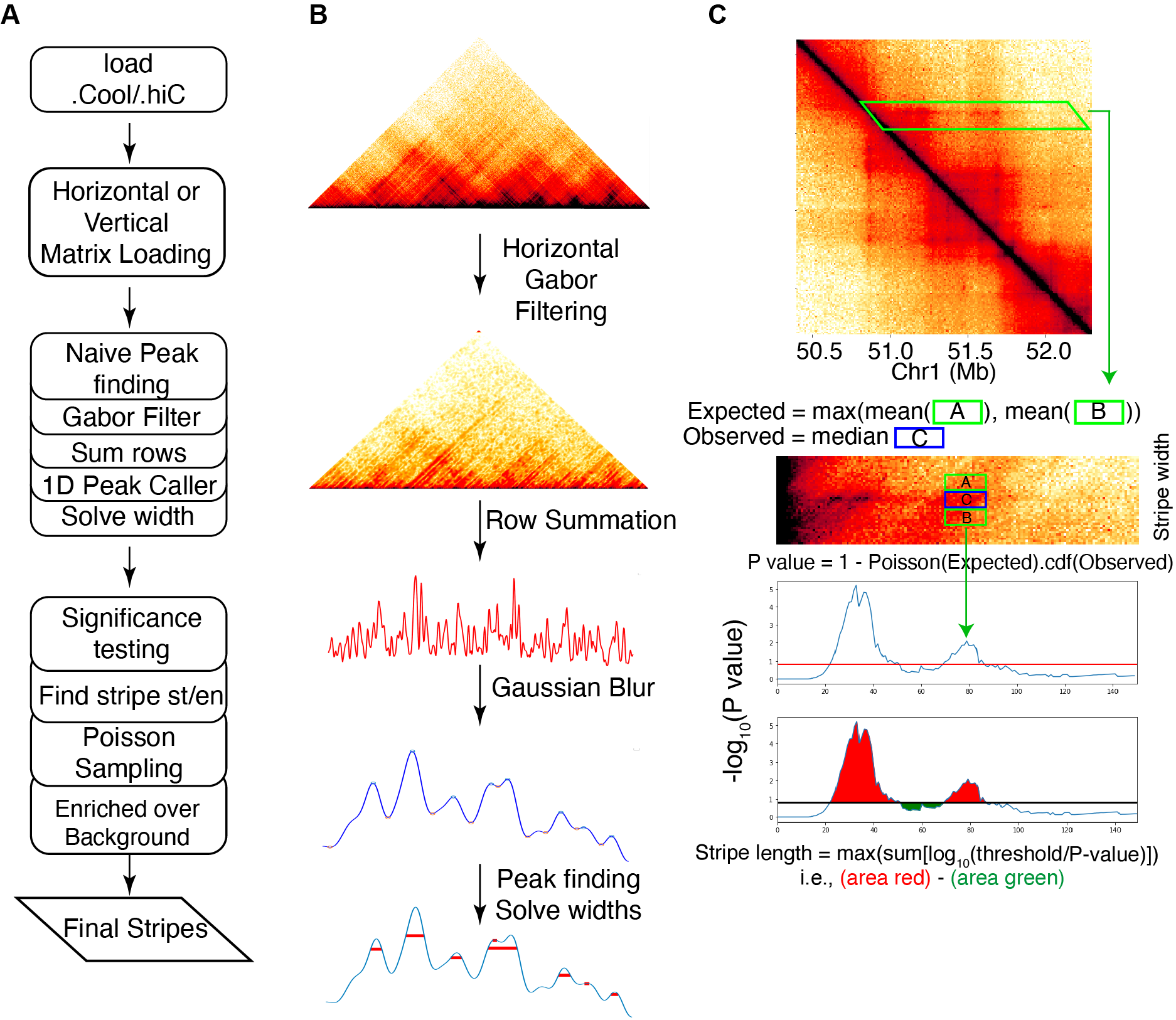
You can read it here: https://genome.cshlp.org/content/36/1/159.full
Quagga is availible to use here: https://github.com/dmcbffeng/StripeCaller